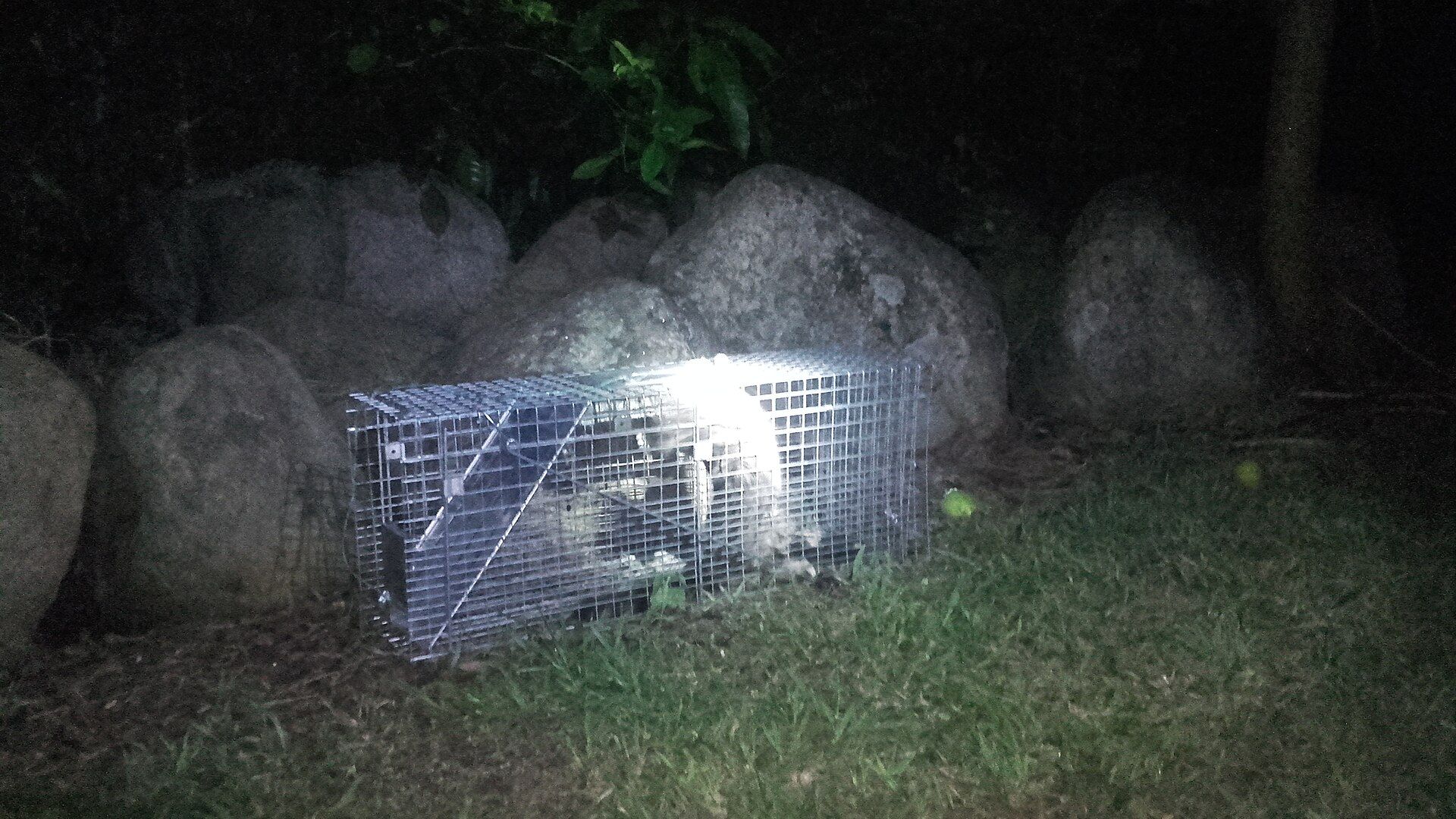

The short answer
In the New York laws reviewed here, we found nothing that addresses trap-neuter-return (TNR) directly, either to allow it or to forbid it. State law protects all animals from cruelty, makes abandonment a crime, sets rabies vaccination rules, and funds a spay/neuter program that cannot be used for community cats.
Local rules vary. In December 2018 the City of Olean changed its code to allow TNVR (trap-neuter-vaccinate-return).
This page summarizes public sources. It is not legal advice. For a question about your property, your town or a dispute, ask your municipal clerk or a lawyer.
What state law says about cats
- Companion animals: Agriculture and Markets Law §350(5) defines a “companion animal” or “pet” as any dog or cat, plus other domesticated animals kept in or near the household. The section does not mention feral cats, and we do not guess how a court would apply it to them.
- Cruelty: §353 makes it a class A misdemeanor to torture, cruelly beat, or unjustifiably injure, maim, mutilate or kill any animal, “whether wild or tame.” That includes community cats.
- Abandonment: §355 makes it a misdemeanor, punishable by up to one year in jail, a fine of up to $1,000, or both, for an owner or anyone in charge of an animal to abandon it. The text does not mention TNR or community cats. If this worries you, ask a lawyer.
Rabies
Public Health Law §2141 requires dogs, cats and domesticated ferrets to be vaccinated against rabies: the first shot no later than four months of age, and a second within one year of the first. Kitten schedules are in our vaccine guide.
The same section says the requirement does not apply to “any feral animal.” Even so, every surgery we help fund includes a rabies vaccine.
An ear-tip, the small straight cut on one ear, is what Neighborhood Cats calls the universal sign of a spayed or neutered community cat and, where required, of one vaccinated at least once for rabies. We found no New York law that gives an ear-tip legal meaning.
State spay/neuter money and community cats
New York’s Animal Population Control Program (Agriculture and Markets Law §117-a) pays for low-cost spay/neuter of dogs and cats whose owners receive public assistance or adopted them from a pound, shelter or humane society. ASPCApro’s page on the program says its funds “may NOT be used for feral or community cat programs,” and lists the program as paused. Check the current status before you apply.
In 2015 the Legislature passed a bill (S1081/A2778) that would have let up to 20% of the fund go to community programs that trap, neuter, vaccinate and return feral cats. The Governor vetoed it on October 26, 2015 (veto memo 203).
So in New York, care for community cats is paid for by caretakers, local groups and donors. In Cattaraugus County, that is the gap our spay/neuter help is meant to fill.
Local rules: Olean and your town
Cities, towns and villages can set their own rules on animals at large, feeding and nuisances. In Olean, the Common Council approved changes to the city Code of Ordinances in December 2018 to allow TNVR efforts, the Olean Times Herald reported in April 2019. We could not retrieve the current code text, so ask the city clerk for today’s wording.
- Ask your town, village or city clerk whether there are local rules on feeding outdoor cats or on animals at large.
- Many municipal codes can be searched online at ecode360.com.
- Do not assume a neighboring town follows Olean’s rules.
What the research says, and what it doesn’t
Whether TNR shrinks outdoor cat populations is debated. Most of the evidence comes from long-running programs studied after the fact, not from controlled trials.
- University of Central Florida: after a long-term TNR and adoption program, the campus counted 68 cats in 1996 and 23 in 2002, a decrease of about 66% (Levy, Gale and Gale, 2003).
- Newburyport, Massachusetts: a waterfront program begun in 1992 with an estimated 300 cats reported none left after 17 years, through adoption and attrition. It is a retrospective case study built from reports and interviews (Spehar and Wolf, 2017).
- Key Largo, Florida: a 23-year program counted 455 cats in 1999 and 206 in 2013, a 55% decrease. The authors note irregular counts and no comparison group (Kreisler, Cornell and Levy, 2019).
- Critics: conservation biologists Longcore, Rich and Sullivan (2009) argue that the scientific literature contradicts claims that TNR eliminates colonies or keeps new cats out, and that TNR decisions should get formal environmental review because of cats’ effects on wildlife.
We support TNR because a sterilized cat has no more litters. We do not claim it solves every outdoor-cat problem, and the mixed evidence above is why.
Quick answers
- Is TNR legal in New York? We found no state law that addresses it directly. Olean’s code allows TNVR. Elsewhere, ask your clerk.
- Is it legal to feed outdoor cats? We found no statewide rule in the laws reviewed here. Local codes vary.
- Does an ear-tip have legal meaning? Not in any New York law we reviewed. It is a widely used sign that a cat has been fixed.
- Can the state spay/neuter fund pay for TNR? No. Its funds may not be used for feral or community cat programs, and the program is listed as paused.
- Is abandoning a cat a crime? Yes. §355 makes abandoning an animal a misdemeanor.
Where to ask
- Your town, village or city clerk: local codes on animals at large and feeding.
- Your town or village attorney, or a private lawyer: liability, disputes, anything about your situation.
- A doctor and your county health department: a bite or possible rabies exposure.
- Us, at (716) 200-1283: help getting community cats fixed in Cattaraugus County. Apply online.
Sources
- NY Agriculture and Markets Law §350 — Definitions (NY Senate)https://www.nysenate.gov/legislation/laws/AGM/350
- NY Agriculture and Markets Law §353 — Cruelty to animals (NY Senate)https://www.nysenate.gov/legislation/laws/AGM/353
- NY Agriculture and Markets Law §355 — Abandonment of animals (NY Senate)https://www.nysenate.gov/legislation/laws/AGM/355
- New York Public Health Law §2141 — Rabies vaccination (NY Senate)https://www.nysenate.gov/legislation/laws/PBH/2141
- NY Agriculture and Markets Law §117-a — Animal Population Control Program (NY Senate)https://www.nysenate.gov/legislation/laws/AGM/117-A
- ASPCApro — New York State Animal Population Control Programhttps://www.aspcapro.org/node/510
- NY Senate Bill S1081 (2015), vetoed October 26, 2015https://www.nysenate.gov/legislation/bills/2015/S1081
- Olean Times Herald — Olean feral cat program picking up steam (April 23, 2019)https://oleantimesherald.com/2019/04/23/olean-feral-cat-program-picking-up-steam
- Neighborhood Cats — Eartippinghttps://www.neighborhoodcats.org/eartipping
- Levy, Gale & Gale — Long-term trap-neuter-return and adoption program (JAVMA, 2003)https://stars.library.ucf.edu/facultybib2000/3885
- Spehar & Wolf — The Newburyport, Massachusetts case study (Animals, 2017)https://pmc.ncbi.nlm.nih.gov/articles/PMC5704110/
- Kreisler, Cornell & Levy — Twenty-three year TNR program in Key Largo (Frontiers in Veterinary Science, 2019)https://pmc.ncbi.nlm.nih.gov/articles/PMC6367225/
- Longcore, Rich & Sullivan — Critical assessment of claims regarding TNR (Conservation Biology, 2009)https://doi.org/10.1111/j.1523-1739.2009.01174.x
This guide is general information for caretakers, not veterinary advice. For a sick or injured cat, call your veterinarian or Veterinary Emergency Clinic, Cheektowaga at (716) 403-4370 (Open 24/7). Questions about our program: (716) 200-1283 · cattcountycatnippers.org