
Before you set a trap
Humane trapping is the first step of trap-neuter-return (TNR). A box trap catches the cat unharmed; a clinic spays or neuters it, vaccinates it and tips one ear; then you return it to the place it lives. New to TNR? Start with what TNR is.
Never trap without a plan for the cat. Before trapping day, book the surgery, get a warm, quiet holding space ready, ask the property owner’s permission where you need it, and check the forecast.
Trapping timeline: from two weeks out to return
| When | What to do |
|---|---|
| About 2 weeks before | Feed at the same time and place every day, as much as the cats eat in about 30 minutes, then pick up leftovers. Count the cats and note any that look pregnant, nursing, injured or ear-tipped. |
| 1 to 2 weeks before | Book one surgery appointment per cat you plan to trap. Line up one trap per cat, plus a sheet or towel to cover each. Start feeding inside unset traps. |
| The day before | Withhold food for about 24 hours, never more than 48. Never withhold water. Get the holding space ready. |
| Trapping day | Set, bait and watch the traps. Cover each trap the moment a cat is caught and move it to the holding space. Allow a second day for the cats you miss. |
| Surgery day | Drive the cats to the clinic in their covered traps, flat and secured. |
| After surgery | Each cat recovers in its covered trap. Most adult cats are held about 24 hours; follow the clinic, which may ask for longer for some females. |
| Return | Once the cat is fully awake and alert, release it at the exact spot where it was trapped, and keep feeding on the usual schedule. |
From Alley Cat Allies’ TNR field guide and Neighborhood Cats. Where your clinic’s instructions on food or recovery differ, follow the clinic.
The Colony Caretaker TNR Binder has a trapping-day plan, a trap log and recovery logs to fill in as you go.
Which trap to use
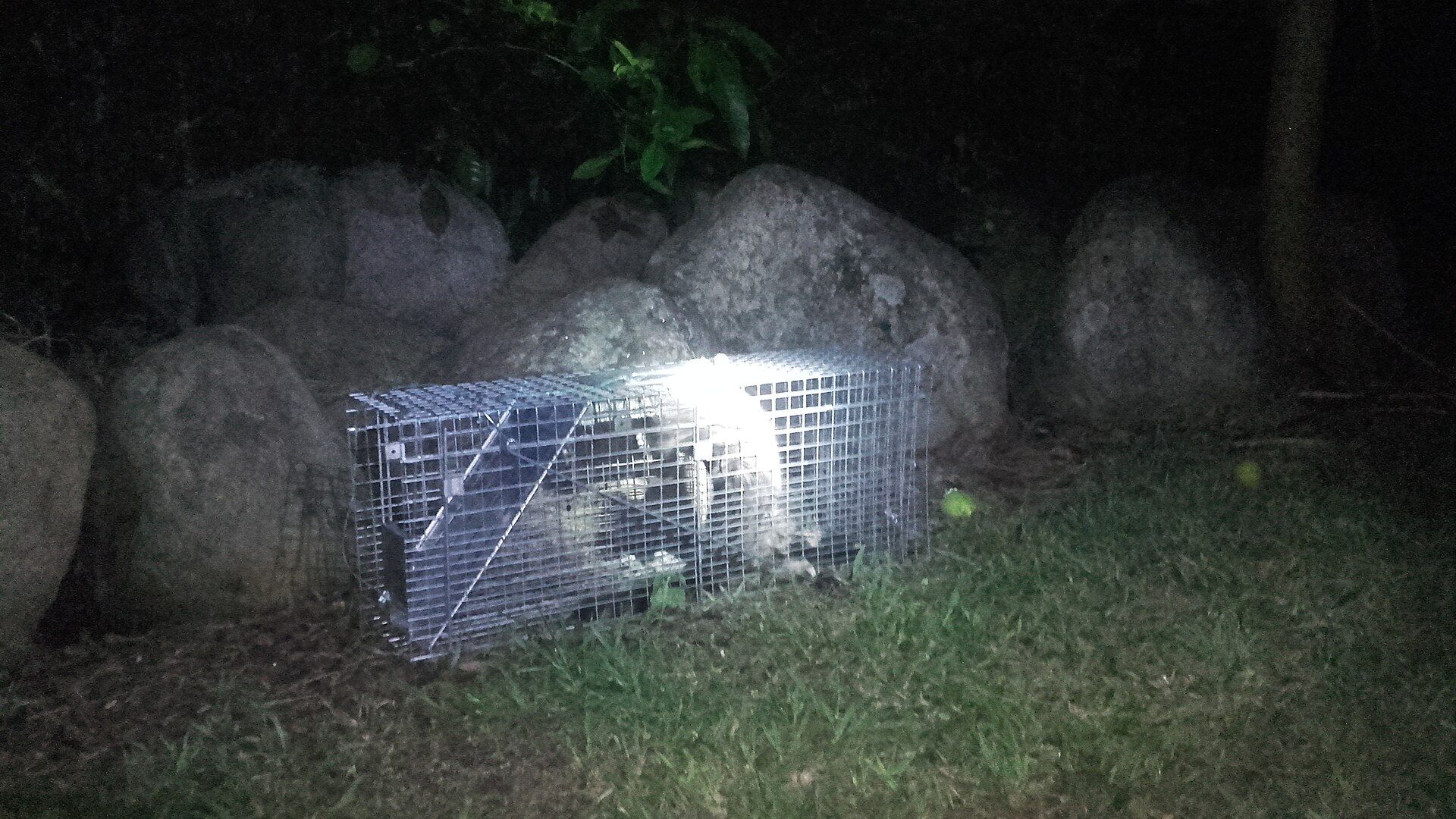
Use a humane box trap, sometimes sold as a live trap: a long wire cage whose door drops shut when the cat steps on a plate near the back. It holds the cat safely until surgery, and the cat can stay in it through recovery. You need one trap per cat, and a sheet or towel to cover each.
Size matters. Neighborhood Cats recommends a trap 30 to 36 inches long and at least 10 inches wide, and the ASPCA’s trapping sheet asks for at least 30 by 10 by 12 inches. A sliding rear door makes it easier to feed a cat, clean the trap and move the cat to a transfer cage.
- Box trap: the standard for TNR. Practice setting and releasing it at home before trapping day.
- Transfer cage: lines up with the trap’s rear door, so a clinic or an experienced trapper can move a cat without letting it loose. Buy it from the same maker as the trap.
- Drop trap: a large frame propped up over food and dropped with a string. Cats are less wary of walking under one, so it can catch a cat that avoids box traps, but it takes two people and some practice. Alley Cat Allies treats it as a last resort.
- Skip “clam” traps, nets, darts and tranquilizers.
- Small kittens can be too light to trip a full-size trap; ask a TNR group or the clinic how to catch them.
Need traps in Cattaraugus County? We lend humane traps to colony caretakers and show you how to use them. Ask on the help form.
Train the cats to the trap
Cats are wary of anything new. For one to two weeks before trapping day, Alley Cat Allies suggests feeding the cats only inside unset traps: tie the door open, or take it off, so it cannot shut. Start with the food near the entrance and move it a little farther toward the back each day. Take the traps away once the cats have eaten, so nobody walks off with them.
When the cats walk in to eat without hesitating, they are ready. Training also helps with a cat that has been trapped before and remembers it.
How to set a humane trap
- Withhold food for about 24 hours before trapping, never more than 48. Leave water out.
- Test the trip plate before you bait: set the trap and press the plate to check that the door drops cleanly.
- Line the floor of the trap with newspaper folded lengthwise, taped down if it is windy, so the cat does not feel the wire or the trip plate.
- Tag the trap with where you set it.
- Put about a tablespoon of strong-smelling food at the very back, behind the trip plate: tuna, mackerel or sardines packed in oil work well. Drizzle a little of the juice toward the entrance.
- Set the trap on level, stable ground where the cats already eat, in a quiet spot away from traffic. A cat will not walk into a wobbly trap. Lay it lengthwise along a wall, fence or bush, not on hot or icy pavement, and space several traps a few feet apart.
- Trap early in the morning, at dusk, or at the time you usually feed.
- Set the door, step well back, and watch from where the cats cannot see you, such as a car or a window.
- Never leave a trap unattended, and never leave one set overnight. A trapped cat can be stolen, hurt, or left in the heat or cold.
Once a cat is caught
Wait until the door has shut and the cat is fully inside, then walk up calmly and cover the whole trap with a sheet or towel. A cat thrashing in a trap usually settles in the dark.
Never open the trap to move the cat or check on it, and keep your fingers out of the wire. Even a friendly stray can bite when frightened.
- Move the covered trap to the holding space: dry, quiet, secure, away from fumes, other animals and people. Neighborhood Cats suggests at least 65°F; Alley Cat Allies, around 70°F.
- Set traps off cold concrete, on a layer of newspaper or plastic to catch urine.
- Transport traps flat and secured, never in a trunk or an open truck bed.
- Keep the cat covered in its trap until surgery, and through recovery afterward.
Who did you catch?
- An ear-tipped cat: the straight-cut ear tip means it has already been through TNR. Check the ear, then release it where you caught it.
- A friendly cat with a collar, or one you think is someone’s pet: ask the clinic or a shelter to scan it for a microchip, and check lost-pet posts. See stray or feral cat?
- A nursing mother (swollen teats, kittens nearby): her kittens need her. A nursing cat can be spayed and keeps making milk, and clinics send her back to her kittens quickly, often the next day. Ask your clinic before trapping day, and see found kittens: what to do first.
- A raccoon, skunk, opossum or other wild animal: release it right away, where you caught it. Open the door from behind the trap and step back. For a raccoon or skunk, drape a heavy blanket over the trap first.
Hard-to-trap cats
- Feed from unset traps for a week or two, food at the entrance at first and farther back each day, until the cat eats inside without hesitating.
- Try a different bait: mackerel, jarred chicken baby food or plain fried chicken, or a pinch of fresh catnip or valerian, inside the trap only.
- Cover the trap with a dark towel, burlap or a cardboard box, keeping the door free to drop.
- Hide the trip plate under newspaper so the cat does not feel it underfoot.
- Use a drop trap, with a partner.
- If the cat stops coming near the traps, take a break of a week or two and feed normally before you try again.
Weather and safety
Alley Cat Allies’ rule of thumb: if it is too dangerous for you to be outside, it is too dangerous for a cat in a trap, which can die of hypothermia or heat stroke. Don’t trap in heavy rain, deep cold or the heat of the day. In winter, trap in the warmest hours and move a caught cat indoors at once. More in how to keep outdoor cats warm in winter.
If a cat bites or scratches you, the CDC advises washing the wound with soap and water for 15 minutes right away. Then call your doctor and your county health department about rabies.
Quick answers
How long should I withhold food before trapping a cat?
About 24 hours, and never more than 48. Never withhold water. A hungry cat is far more likely to walk into a trap.
What is the best bait for a cat trap?
Something strong-smelling: tuna, sardines or mackerel, about a tablespoon at the back of the trap, with a little juice dribbled toward the entrance.
What size trap do I need for a cat?
A box trap 30 to 36 inches long and at least 10 inches wide, one per cat, plus a sheet or towel to cover each.
Can I leave a trap set overnight?
No. Never leave a set trap unattended or out overnight. Watch it from a distance and move a caught cat to shelter right away.
What do I do after the cat is trapped?
Cover the trap, keep it closed, and move it to a warm, quiet holding space until surgery. The TNR guide covers surgery, recovery and return.
Checklist
- Surgery appointment booked before trapping
- One humane box trap per cat, plus a cover for each
- Food withheld about 24 hours, never over 48 (water always left out)
- Newspaper liners, bait, a tag for each trap
- Warm, quiet holding space ready
- Traps watched at all times; caught cats covered at once
- Return plan: the same spot each cat was trapped
Free, by email
Get the free colony roster, plus seasonal care notes
A printable roster for every cat in your colony: who is fixed, who is ear-tipped, and who is next. Sent to your inbox. After that, a short email when the season changes: winter shelters, kitten season, trapping weather.
Check your inbox
We sent a confirmation link to . Click it and we’ll email you the roster. Nothing there in a few minutes? Check your spam or promotions folder.
Sources
- Alley Cat Allies — TNR Field Guide (PDF, 2025)https://alleycat.org/wp-content/uploads/2025/03/tnr_field_guide_english_web.pdf
- Alley Cat Allies — How to Catch a Feral or Stray Cat with a Traphttps://www.alleycat.org/community-cat-care/steps-for-a-successful-trapping-day/
- Alley Cat Allies — Trapping Equipmenthttps://www.alleycat.org/community-cat-care/trapping-equipment/
- Alley Cat Allies — Tips for Hard-To-Trap Catshttps://www.alleycat.org/tips-for-hard-to-trap-cats/
- Alley Cat Allies — Keep Community Cats Comfortable While in Their Traphttps://www.alleycat.org/community-cat-care/keep-community-cats-comfortable-while-in-their-trap/
- Alley Cat Allies — TNR Scenarios: Nursing Mother Cathttps://www.alleycat.org/community-cat-care/tnr-scenarios-nursing-mother-cat/
- Neighborhood Cats — The 7 Steps of TNRhttps://www.neighborhoodcats.org/how-to-tnr/getting-started/the-7-steps-of-tnr
- Neighborhood Cats — Traps and Equipmenthttps://www.neighborhoodcats.org/how-to-tnr/trapping/traps-equipment
- Neighborhood Cats — Drop Trapshttps://www.neighborhoodcats.org/how-to-tnr/trapping/drop-traps
- Neighborhood Cats — TNR Handbook, 2nd edition (PDF)https://kotorkitties.org/wp-content/uploads/2021/01/nc_tnr_handbook_2d_ed_2_7mb.pdf
- ASPCApro — Community Cat Trapping Guidelines (PDF)https://www.aspcapro.org/sites/default/files/2025-07/community_cat_trapping_guidelines.pdf
- CDC — Preventing Rabieshttps://www.cdc.gov/rabies/prevention/index.html
This guide is general information for caretakers, not veterinary advice. For a sick or injured cat, call your veterinarian or Veterinary Emergency Clinic, Cheektowaga at (716) 403-4370 (Open 24/7). Questions about our program: (716) 200-1283 · cattcountycatnippers.org